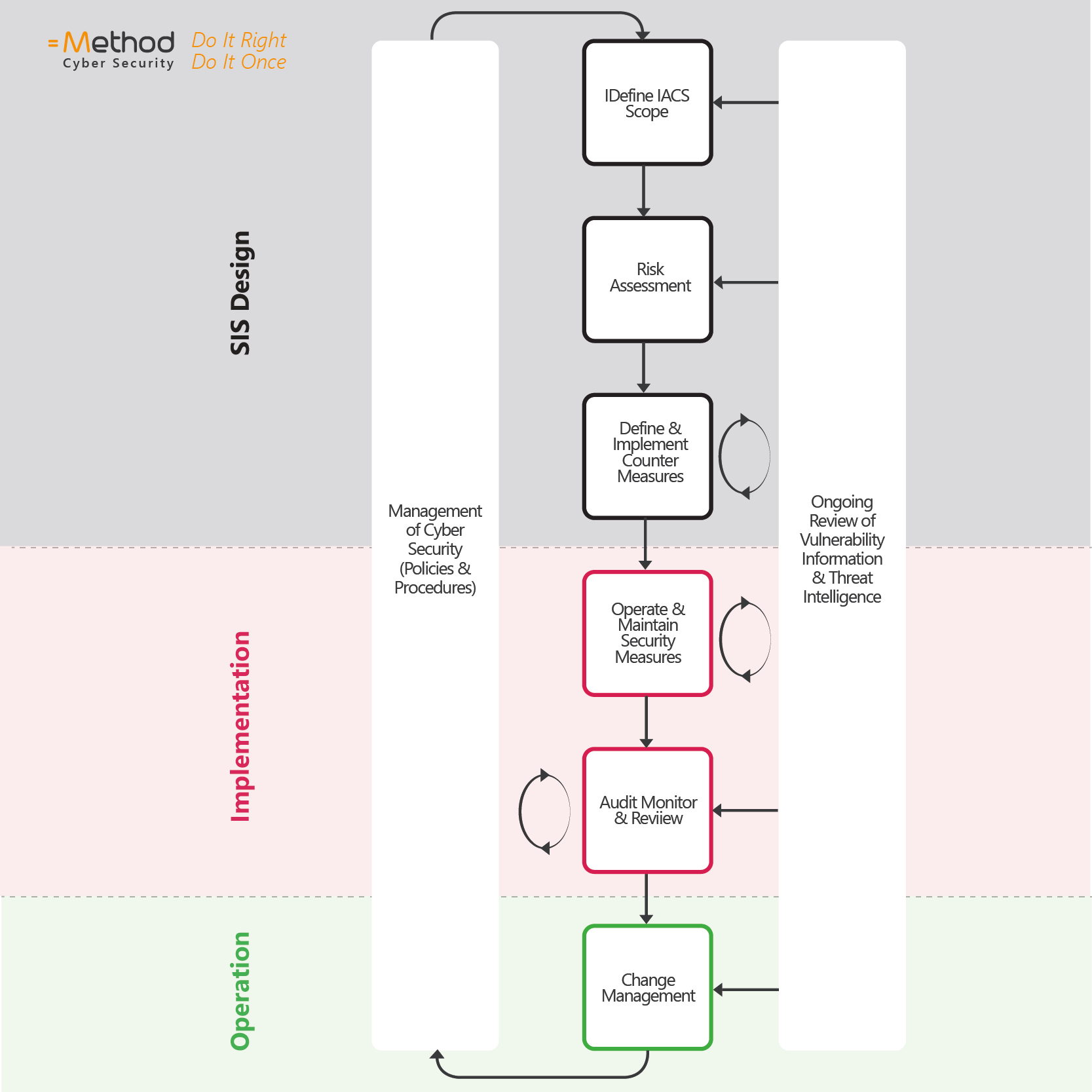
What Is a Cyber Security Risk Assessment?
Once the IACS infrastructure and data flows are understood, you can develop risk profiles for each zone and allocate a criticality or security level to the zone defined by the potential consequence arising from compromise of the assets or functions of that zone.
What Is a Cyber Security Risk Assessment?
Similar to a process safety risk assessment, a cyber security risk assessment should define the potential worst-case outcome for each zone relative to the organisation’s regulatory framework e.g. COMAH, or to a corporate risk matrix (for companies not operating under a legal duty to implement OT cyber security practices). OG86 requires that Major Accident (safety, health, and environmental) and Loss of Essential Services consequences are examined, for organisations falling under the HSE’s authority, however, companies operating under different or no regulatory framework may wish to include other risk metrics e.g. business continuity, profitability or reputation.
Risk assessments require input from a broad range of competencies
IACS responsible persons (Duty Holder in Major Accident workplaces),
- Control and Instrumentation Engineers
- IACS vendor representatives
- IT / network specialists
- Process Engineers
- Production stakeholders
It is also important to include representation from other business functions which can impact the cyber security and resilience of chosen IACS and security systems e.g. Procurement, Human Resources and Legal Departments.
Methodologies for conducting cyber security risk assessment
There are many methodologies for conducting cyber security risk assessments, e.g. the ISA/IEC 62443 high-level cyber security risk assessment which is taken as the basis of the OG86 Appendix 4 risk assessment example. Unlike process safety risk assessments, a cyber security high level risk assessment assumes a threat likelihood of one (certain to occur) and focuses on evaluating the worst-case outcome of an IACS zone or asset being compromised to determine the areas of highest risk.
Risk Assessment scenarios
The risk assessment scenarios need to be realistic and feasible so should be based on up-to-date vulnerability information and threat intelligence relevant to the IACS hardware, software and architecture defined in the organisation’s simple network diagram and IACS asset register and must be initially assessed without taking credit for any existing cyber security countermeasures.
A high level cyber security risk assessment methodology is summarised in the flow chart below:
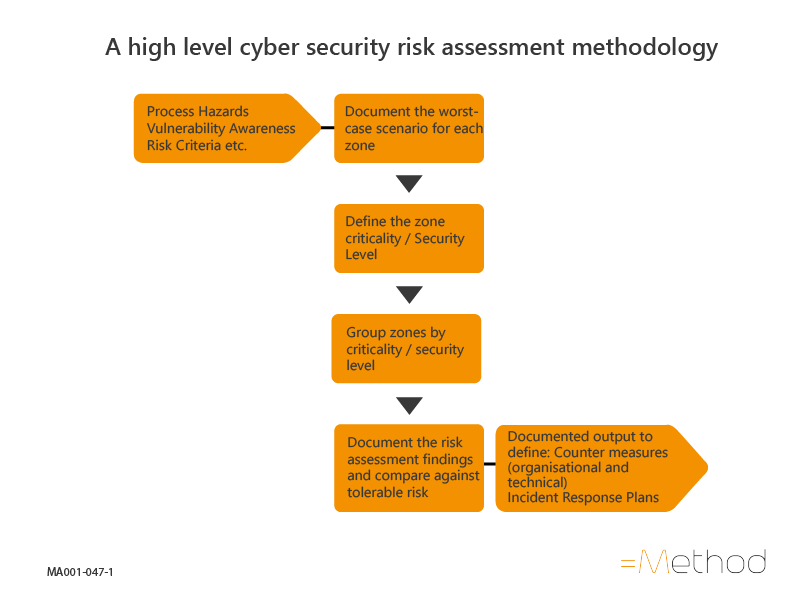
Where the high level risk assessment identifies risks which exceed the organisation’s tolerable risk criteria, further detailed cyber security risk assessments should be performed to identify additional countermeasure necessary to reduce the risk.
A key countermeasure is the secure design and segmentation of the zones and conduits.
Technical author
Steve Essery
Technical Director at Method Cyber Security & Group Quality Assurance Manager at Method Safety and Security
Since 2019, Steve has worked as a contract Functional Safety Professional and Cyber Security Specialist, and as a Regulatory Compliance Consultant and Equipment & Control Systems Validation Specialist within the pharmaceutical industry, before becoming a Technical Director at =Method.