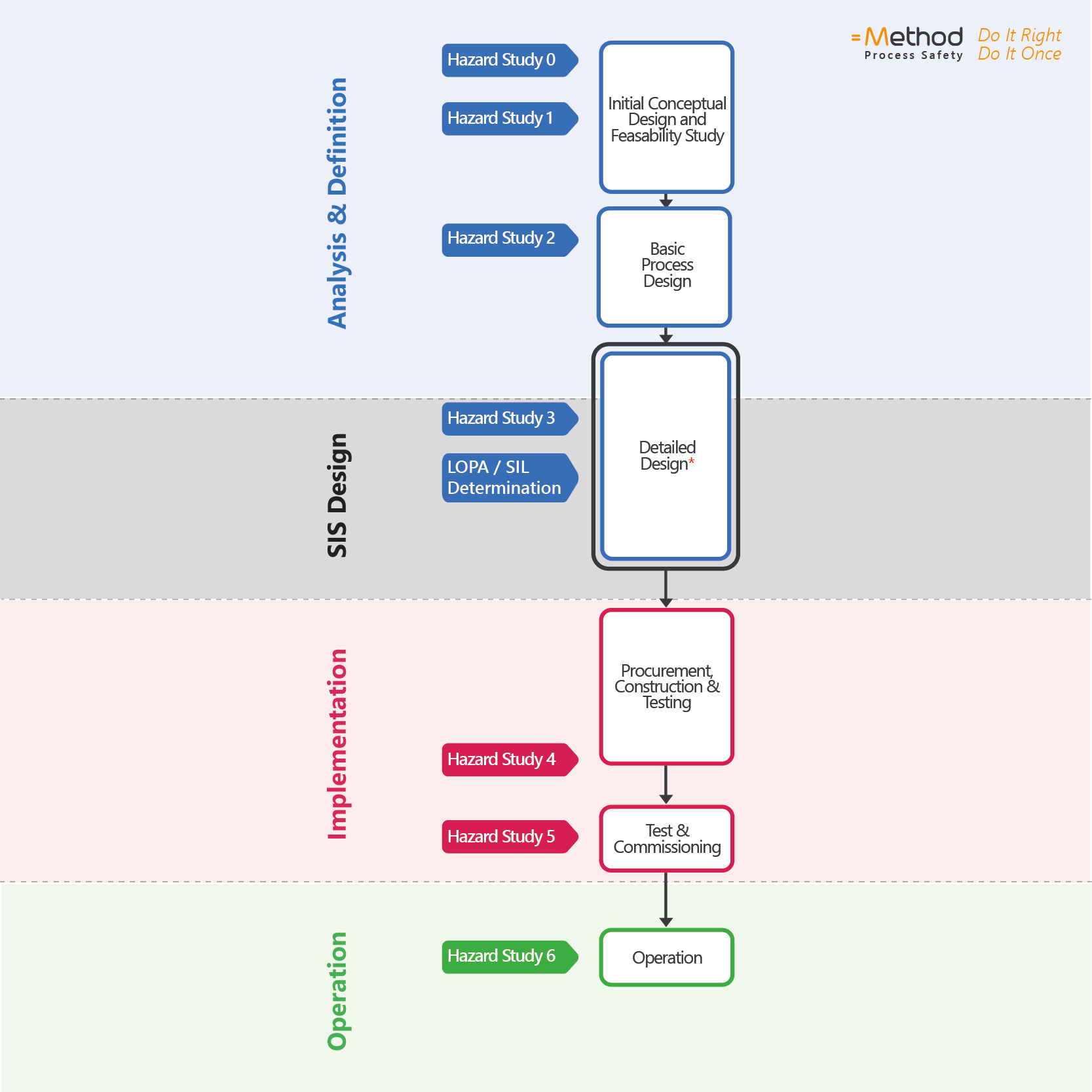
What is Detailed Process Design?
At the detailed design phase, P&ID Piping & Instrumentation Diagrams are developed and more detailed design decisions are made, such as line sizing, pump sizing, and types of valve to be used.
At this stage of the process the design pressure of vessels will be known, equipment sizing will be completed and the materials of construction decided upon. Decisions will also be made on the process control philosophy and types of instrumentation to be used.
Hazard Study 3 (HazOp) is typically carried out at the start of the detailed design stage (as soon as the P&IDs have been ‘frozen’) and may be revisited at various points during this phase as the design progresses and HazOp actions are completed. HazOp has over time become the de-facto standard method for risk assessment on process plant. It uses a set of guidewords to analyse the effect of potential deviations from the design intent and the impact these could have on the process. For a more detailed description of HazOp, see the HazOp Page. The main aim of a HazOp study is to identify hazards and determine if the risk control measures specified reduce the risk to a tolerable level.
Following HazOp, high-risk and high-severity (e.g., fatality) scenarios may be selected and examined in more detail using a technique such as Layer of Protection Analysis (LOPA) to ensure that the company’s tolerable risk targets have been met. The output of the LOPA may also require further analysis to demonstrate that the risk has been reduced to “As Low As Reasonably Practicable” (ALARP).
Other process safety activities carried out during detailed design include writing the COMAHControl of Major Accident Hazards safety report for the plant (if required) and if there are flammable materials involved, completing the DSEARDangerous Substances and Explosive Atmospheres Regulations risk Assessment.
If the plant requires a SISSafety Instrumented System, then its design is part of the detailed design phase.
Carrying out competence assessments before HazOp, and having the study independently verified helps greatly during later functional safety lifecycle phases, and during the Stage 1 Functional Safety Assessment (FSA 1) which is intended to confirm the compliance with IEC 61511.
Because HazOp is intended to fulfil the requirements for Hazard & Risk Assessment (H&RA) within the Functional Safety Lifecycle, it must be carried out in a manner that complies with the functional safety standard, IEC 61511.
This standard requires that procedures are in place to manage functional safety, and this applies during the HazOp, as well as during SIS design. HazOps therefore require functional safety plans to be in place, as well as procedures to ensure the competence of the team carrying out the HazOp (something that is often missed). Because Hazard & Risk Assessment (H&RA) is a stage of the functional safety lifecycle, the study worksheets and report also need to be independently verified (checked) to ensure their adequacy.
Detailed process design also includes the specification of any SIS, which will itself be subject to a stage 1 functional safety assessment (FSA1). The FSA1 will review the approach taken to H&RA and cannot find the project compliant if the HazOp was not not properly planned, executed and verified.
What =Method can do for you
Provide experienced study facilitators for HS3 (HazOp) and Layer of Protection Analysis (LOPA) studies.
Verify studies carried out by others.
Train and give mentoring support to aspiring hazard study leaders and LOPA facilitators.
Provide Training for HazOp team members – either as a standalone course or as part of the preparation for delivering a particular study.
Support delivery of ALARP demonstration.
Carry out Stage 1 Functional Safety Assessment.
Carry out a Stage 2 Functional Safety Assessment (once the SIS design is finished).
Assist with COMAH applications or changes to existing COMAH safety reports.
Carry out DSEAR risk assessment.
Technical author
David Sparkes
Technical Director, Method Process Safety
David is an experienced process engineer with a solid background in plant support, capital projects and control system design.
4 x Recent =Method Process Safety Detailed Process Design Projects
Series of Hazard and Operability Studies on various processes for a novel glass manufacturing process.
Industry: Other
Topic: Hazard Study 3 - Hazard and Operability Study (HazOp)
Hazard and Operability study of novel glass manufacturing process.
Industry: Other
Topic: Hazard Study 3 - Hazard and Operability Study (HazOp)
LOPA following earlier HazOp to establish the effectiveness of existing and intended protection layers and safety functions at a hydro electricity facility.
Industry: Water + Waste
Topic: Layer of Protection Analysis (LOPA)
Layer of Protection Analysis for Hydrogen Energy Management System (EMS).
Industry: Other
Topic: Layer of Protection Analysis (LOPA)